Ecological Detection dogs

Bat and Bird Fatality surveys
We provide specialist detection dog services for bat and bird fatality surveys across the UK.
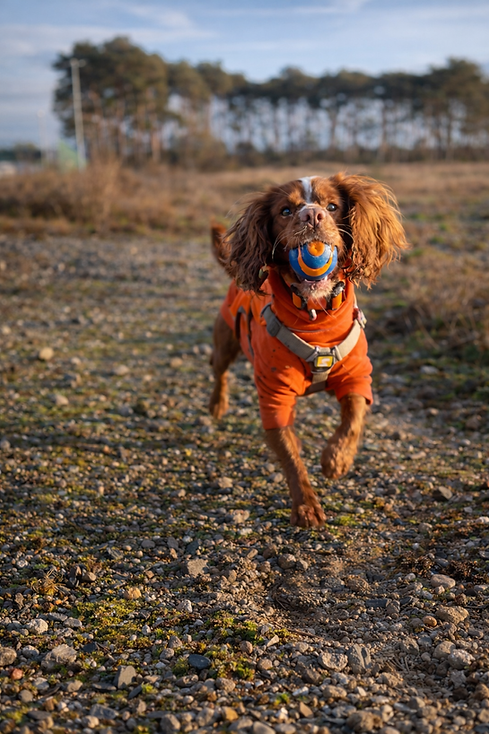
Our team currently consists of three detection dogs and one handler. We are actively deployed on live projects nationwide.
Wren, Molly, and Addie have demonstrated 100% odour recognition and 80% search efficiency under operational conditions. All three dogs have been externally tested in 2026.
Each dog is externally assessed for detection suitability on target odours, and the handler has been independently assessed for competency by multiple detection organisations.
Water vole detection
We provide specialist detection dog services for water vole surveys across the UK.
Our dog Wren has demonstrated 100% odour recognition, with a 75% detection rate under operational conditions locating evidence down to a single water vole dropping.We have recently undertaken research into water vole detection in collaboration with the University of Plymouth. The findings indicate that vegetation structure particularly dense ground cover is a significant factor influencing detection speed. This research has directly informed and strengthened our professional survey methodology. By understanding how vegetation structure influences detection performance, we are able to adapt search strategies to maximise accuracy and reduce the risk of missed detections in complex habitats.
Our collaboration with the University of Plymouth reflects our commitment to contributing meaningfully to professional ecological surveys and supporting ecological consultancies with robust, evidence-based practice. We continually strive to improve standards within detection dog surveying by working with science-backed data, refining our methods, and ensuring our approach remains transparent, defensible, and aligned with best practice.
All dogs are externally assessed for detection suitability, and the handler has been independently assessed for competency by multiple detection organisations.


Pine Marten Detection
Detection dog services for pine marten surveys will be available in 2026, featuring “Molly,” a specially trained detection dog currently being imprinted on pine marten scat. This focused training ensures precise scent recognition and high levels of accuracy in locating target samples in the field.
Molly’s performance is being independently assessed through structured efficiency trials. These trials measure detection success, false positives, and search coverage under a range of environmental conditions. The results are used to benchmark her performance against existing survey methods, ensuring a reliable and effective service for ecological monitoring and conservation projects.
This rigorous training and evaluation process will support the delivery of a dependable, non-invasive survey method to help monitor and protect pine marten populations.
American Mink detection
Detection dog services for American mink surveys will be available in 2026, featuring “Addie,” a trained detection dog currently being imprinted on American mink scat. This targeted training enables highly accurate scent recognition, supporting effective identification of this invasive non-native species in a range of field conditions.
Addie’s performance is being independently evaluated through structured efficiency trials, assessing detection rates, false positives, and search coverage. These trials ensure her reliability is benchmarked against existing survey and monitoring methods, providing confidence in the service.
This approach offers a robust, non-invasive tool to support control and monitoring programmes, helping to manage and reduce the impact of American mink on native wildlife and ecosystems.


Research collaborations
and
Scope for new projects
We are proud to actively collaborate with academic institutions to strengthen the evidence base behind conservation detection dog work.
University of Plymouth – MSc Research Project
“Habitat Effects on Detection Time in Water Vole Surveys Using Conservation Dogs”
Conducted by Dylan Thomas (MSc)- This project examined how habitat structure influences detection time during water vole surveys. The research has contributed directly to refining professional survey methodology, supporting more defensible, science-led ecological consultancy practices.
University of Exeter– PhD Research (Truffle Detection) with Kat Schmidt - We are also supporting doctoral research into truffle detection, focusing on species within the genus Tuber (true truffles). This work explores detection reliability, scent discrimination, and field application in ecological and mycological contexts.
Future Opportunities
We welcome opportunities to collaborate on new projects across conservation, ecological consultancy, and applied detection science. If you are interested in developing a research partnership, please get in touch to discuss potential collaborations.